Showing posts with label Belted Galloways. Show all posts

Monday, October 3, 2011

Progress report on calving

St
We have 21 cows due to calve this year - with only one maiden heifer (2008 produced 8 boys and a girl).

As of half an hour ago ... we had 10 calves - with no problems and no losses.  Here is the latest arrival to a cow called Haviva.

Yesterday Grumpy-bum, otherwise known as Sarah, calved and wanted me to leave the paddock forthwith.

A day earlier she had upset the Chairman (woman) by trying to chase her out of the paddock when we were just trying to move them to the best paddock on the place.

I gave her a quick tap on the nose with the nearest thing to hand (an electric fence Tread-in) - then felt guilty about it.
F


Sunday, September 18, 2011

WWOOFing

S
Our son has done the work to register us as hosts under a scheme called Willing Workers On Organic Farms.

We now have a host number - VM 259 - and we are waiting for someone to tell us they want to work with us for 4 to 6 hours a day in return for board and lodging.  Someone who does this is called a WWOOFer.

We are not a certified organic property.  We don't have to be - it's enough that we are mainly organic and don't ask our WWOOFers to use any chemicals or non-organic remedies. 

A neighbor has been hosting WWOOFers for some time - and we've had a couple of groups of them around to dinner - just to give her a break.  They were all nice kids.

We have quite a lot going on at present, so it will be good to have some help.  The two Maremma pups take quite a lot of time.  They are fed 3 times a day and taken for a short walk each time.  We're also trying to socialise them to the animals they have to guard as well.

Josie is doing well with the chooks, but still needs to be supervised.  The sobering part is that she will need to be supervised until she 'matures' - which could be a year away!

Polo is also doing ok with the sheep, but we definitely need to supervise his interaction with the ram.  Even the ewes are a bit aggressive with him.  He, for his part, is wanting to run around and play.  When the ram does try to butt him, Polo stands up for himself by barking and 'charging' back in a 'get off me' sort of way.  Having observed it a couple of times I think it's borderline what he should be doing to establish his role as their protector.

People say that it's best to get a pup and train them yourself - but that's a non-trivial undertaking.

Yesterday we drove down to Buln Buln in Gippsland and bought 6 fresian steers from a dairy farmer.  Our reason for doing so is that we just don't have enough cattle to eat all our grass at Moora - let alone at the leased farm at Benson Rd.

We now have 6 steers of about 6 weeks old.  They were advertised as weaners, but are really a bit young for weaning I think.  We have a bag of milk powder / calf formula and have started out giving them 2 litres each once a day.  The farmer gave us an old feeder - which I think was a hint to continue giving them milk for at least a week or two. 

We will probably get another 6 in a few weeks, but will see how these ones go first.  Whereas we grow our Belted Galloways to sell the meat direct to consumers, we intend that the dairy breed steers will be grown through to the end of Spring next year - and sold on the market.

Moora is 57 acres.  Benson Rd is around 100 acres.  I think, with the effort going into cell grazing, we can look at eventually having a herd of 50 Belted Galloway cows - plus the growers that come from that.  Taking the steers through to 24 to 30 months will give us about 125 head.  At present we have nearly 60 - so with a few more calves ... we'll be half way there.
F

Saturday, September 10, 2011

Good days ... and better

S
Yesterday we got our first calf of the year.  The mother is Hargit and it is her fourth calf with no dramas.  I got progress reports by email - including that it was 7 degrees and hailing in the hours after she was born.

It was still very cold when I got home and all I did was look out into the paddock.  I couldn't see it so wondered if it was ok.  There was a different explanation which became obvious this morning.  I went to shift the cattle at 7 am and the calf was there and looking good and strong.  I let the cattle through into the next area that has long thick pasture including phalaris over a metre high.  The calf promptly disappeared.  I could see where Hargit was, a little separate from the others, but from less that 10 metres there was no sign of the calf.  Good instincts if there were to be predators around - particularly as Hargit was keeping a careful eye on me and the dog.   

Thursday was not so good.  We currently have six Dorper ewes.  Five lambed a few weeks ago.  I had begun to wonder whether the other had lambed and lost it as her udder looked full.  Then Kristina came in saying "The last ewe is lambing".  By the time I got out to it an hour or two later, it had two lambs, but both dead.  With only six animals those two were the difference between a lambing percentage of 117% and one of 83%.  I could have gone straight out, but I don't want to have to lamb ewes or calve cows.  I'm prepared to cull for this.  I have to concede to wondering about the longer term wisdom of human obstetric practises.  

We now have a second Maremma pup and are putting quite a bit of time into their training.  Polo has got shifted onto the ewes and lambs - as he is the more confident animal.  Josie is a little bitch - and a bit of a sook.  She has got the chickens to look after.  She was a week or two younger than Polo when she came home - and the first to leave the litter.  Inevitably it must have been a bit stressful going from 6 litter mates to a paddock.  We are feeding them 3 times a day and walk them around the boundaries of their area before each feed - plus a bit of supervised contact with the animals they are being bonded to.  It's quite a time consuming task - and Kristina is doing most of the work.  It's a bit sobering to know that they won't be fully trained as guardian dogs for more than a year.
F
  

Thursday, July 21, 2011

Cold and wet

S
I suppose at the end of July things should be cold and wet.  While we were away the cattle stayed on pasture, but I have put them into the feed yard since and have been feeding them hay.

This keeps them off the paddocks when they are at their wettest.  It will also use up some 2009 hay that I have left.  It also produces a bit of waste hay mixed with manure to turbo charge our compost.  This year we got access to some rain damaged hay from a neighbour.  We've now picked up most of it and put it straight into the compost bins.  By the time we're finished we'll have at least 4 compost containers - each 6 metres in diameter and about a metre deep once the material composts.

That is about 120 cubic metres of compost.  I'll add that to a similar quantity of chicken manure and rice hulls and put it out on my paddocks.  Actually 250 cubic metres will cover nearly half this farm!  This last year I did about 15 to 20%, but only the first 5% with compost.  From what I read and understand the compost mix should definitely be better than just the 'chicken & rice'.

Nothing much is growing at the moment - other, hopefully, than calves in cows.  It won't take long though and Spring will be here.  Last year growth didn't seem to take off until late September.  I can't wait to see how this year goes.
F

Sunday, March 6, 2011

Is it Australia? Or New Zealand?


This is the view west across paddock 44 at the end of an Australian summer.  We cut hay just on 2 months ago.  Then I spread perhaps 30 tonne of chook manure and compost.  

St 
[Double click for full screen view]

At this time of year we would usually be brown and dry, dry, dry.  This year we're green, green, green - and not that wet really.  I guess we've had 300 mm over the 3 months of summer - some of it was pretty heavy, but spread out like New Zealand - a week or 2 or 3 apart.

I'm thinking of mulch mowing at least one of the paddocks and leaving it on the paddock - just to see the effect of an on site composting.  I'm also doing this at a leased property where there is long rank grass over quite a large area that, 12 months ago, was bare to the point of quite serious erosion risk.  This happens when there are too many kangaroos coming out of the bush.

Sixteen cows and their calves have now had their time at Moora Farm with the bull and returned to their homes for most of the year - on other farms nearby.  As a result I have only 14 animals at Moora Farm - and there is no way they can keep up with growth.  I have the 2009 calves at another agistment property.  I'll get them home soon - and that will help.

Anyone reading this in the Gisborne area (Macedon Ranges really) who is interested in agisting cattle for us - please get in touch.  We have a variety of ways it can work.  The main thing is that you can get to look after some beautiful cattle - but with a good support structure if you're a beginner - or just not having to worry about things if you're more experienced.

The cattle are Belted Galloways and have what my dear wife calls 'high paddock appeal'.  Just this morning I picked up the start of a new agistment option - another animal with high paddock appeal as it turns out - see the next blog post.
F

Thursday, January 27, 2011

Moora Beef outcome

S
Three weeks ago one of our Belted Galloway steers went to slaughter.  We spent the early morning of Australia Day making up 10 kg boxes of aged, grass fed beef.

Believe it or not, a 580 kg animal became 15 boxes (most of which were 10.5 to 11 kg) - plus a bit left over for us.  I was aware that a carcass is usually 50 something percent of liveweight.  Well ... meat yield is 50 something percent of that by the time bones and other trimmings are discarded.

The good news is that the meat looks excellent - and it all sold in a day - with most to our neighbours in South Gisborne. 

Each box is made up of a mix of cuts that is similar to what we get from a carcass.  A sample pack consisted of:
Topside roast - 1.1 kg
3 medium scotch fillet steaks - 0.7 kg
2 bigger porterhouse steaks - 0.7 kg
1 piece of rump steak - 0.6 kg
1 piece of round steak - 0.7 kg
3 oyster blade steaks - 0.8 kg
Corned beef - 0.8 kg
3 osso bucco - 0.8 kg
Stewing steak - 1 kg
Pack of plain sausages - 0.7 kg
Pack of garlic sausages - 0.6 kg
Pack of Chorizo sausages - 0.6 kg
2 packs of mince - 1.4 kg
Total - 10.5 kg

Buyers lose the ability they have at the butcher to choose the exact quantities and cuts they want, but they get meat from a known animal that was treated well its whole life.  The only things it ever ate were pasture,  hay and Olsson's mineral licks.  I guess most of our customers have driven along Couangalt Rd and watched our cattle grazing.

If you were to come to the farm I could show you the 2 or 3 steers from which I'll pick the next guy.  I love my animals as much as anyone, but their reason for being is to provide meat.  I honour them by taking the best care of them that I can -  up to the day where they satisfy the purpose for which they were bred.  As Joel Salatin says - 'Just one bad day'.


I remember Erez (the animal we slaughtered this time) as a calf.  He was the son of one of my favourite cows - Annie.  He was named after a guy I worked with in Israel a few years ago.  The Israeli Erez was a good guy - and a lot quieter than most Israelis.  I have to say Erez (the steer) was a bit 'spookier' - and always needed to handled gently.

Annie is a lovely quiet cow who has produced 5 calves in the 5 years I've had her.  I saw her earlier this evening feeding her 2010 calf - a fiesty little heifer called Maya.  I thought how well she looked - leaner than she was in the Spring - because she's feeding a growing calf.  I expect she'll already be pregnant again, although Maya will stay with her until May.  She'll then get a few months peace before (I trust) another calf in September.


We charge $150 for a 10 kg (minimum) box of Moora Beef.  The quantity is such that a reasonable size fridge and a small freezer will allow it to be used over a period that doesn't require anyone to 'overdose' on red meat.  

The price gives us a modest premium over selling the meat into the 'system' - actually a bit more modest than I'd like - but we're still learning.  The most important thing at present is to make sure what we're producing is of high quality and appreciated - and that we make the slaughtering, butchering, packing and marketing process one we can sustain.

I've checked back and found a photo of Erez with Annie when he was only a few days old.  It was very dry at the time.  I guess we were part way through the pasture renovation at the time - which is why it looks so bare.  Not like that now!
F

Sunday, December 26, 2010

One hard working bull

S
Our new bull is one hard working animal!

He does have 20 girls to cover over the next 2 months (time for 3 cycles), but by the evidence of what he is up to every single time I go to the paddock, I don't think he will need that long.

Our other bull was much less active - and also threw an awful lot of white socks - which a Belted Galloway is not supposed to have. 
F

Cell grazing made easy

S
For several months now I have been cell grazing my cattle.  It's a system, invented (apparently) in New Zealand, of forcing stock to graze more effectively by confining them each day to an area determined by the amount of feed they can eat in that day.

This photo shows 50 cattle immersed in their new patch of pasture.  Immersed is the right description at present as the grass is about 4 feet high.  It's all very well to say it shouldn't be this long, but after the best year for (almost) forever, I simply can't keep up with the feed.

Allowing the pasture to go to seed the way it has this year diminishes the feed value, but will help thicken up the sward as the seeds fall to the ground - or go through the stomachs of the cattle - and back to the same place.  Also, they say that a plant's roots are usually as deep in the ground as the foliage is above it.  If that is the case, I've got roots going down further than they have been for quite some time.  They will help open up channels for improvements in soil biology and soil carbon sequestration.

My guru Joel Salatin says that cell grazing has helped him produce 400 cow days of grazing per acre per annum from his pastures - when the county average is around 80 cow days using set stocking.  Set stocking is the more traditional system of putting cattle into a larger paddock for a longer period.

Salatin (and other proponents) say that stock graze more efficiently and less selectively under cell grazing.  They also deposit manure more evenly across a paddock.  Pasture then gets complete rest until it is ready to graze again.

Temporary electric fencing is what makes it possible.  Most stock respect an electric fence - and my quiet, well mannered cattle respect a single wire electric fence.  So, with a perimeter hot wire in every paddock, its is just a matter of temporary fencing off the right sized area - and making sure they still have access to the water through.

Last week I made one of those small breakthroughs that make farming fun for me.  Along with my mate James the Trailer Doctor, I came up with a design for a brace for the star posts I use in my temporary electric fencing.  Although single wire electric fencing is light, end assemblies on temporary fences still work better with some form of support.

Here is what we came up with.  It is made out of left over bits of box section - 40 mm I think.  That lets me drive the star post in through the top.  The foot (cross piece of the T) has 4 spikes on the bottom of it that anchor it nicely.

If I want to change the direction of tension, I just lift up the brace and swing it around ... then tread it in facing the new way.

I got James to make 4.  As soon as I used it, I put in an order for more. 

I'm feeling particularly pleased because I think my old Dad, were he still around, would approve. 
F

Thursday, December 23, 2010

Sad day

S
 It's not 20 calves from 20 cows any more.

Yesterday no 20 (named Puni), which had been struggling anyway, started refusing to feed and looking more and more poorly.  At lunch time today I took her over to the vet who found she had infected joints in two legs.  They checked her out thoroughly and called me mid afternoon to say she had a poor prognosis - and ask me what did I want to do?

There was no guarantee she would pull through at all - but the real problem was that, even if she did, she would almost certainly have structural weakness in those two legs.  Her function in life, if she had been healthy, would have been to spend 10 to 12 years producing a calf a year.  It's harder to do that on wonky pins.

With much regret I told the vet to put her to sleep - and send me the bill.

The mother was a heifer called Trish - not Henny as reported earlier.  I'm not 100% sure how the initial mis-mothering occurred, but I won't cull Trish on one failure.  She'd better not have another next year though.
F

Sunday, December 19, 2010

Twenty cows - twenty calves

S
One of my helpers on the farm says pragmatically - 'where there are livestock, there will be dead stock'.   He says so because, even with our best efforts, we can't guarantee good outcomes for our animals always.

But I am feeling very pleased with myself at present.  This year my 13 cows and 7 heifers have produced 20 live healthy calves.  All births were unassisted - including the heifers.  We've had cattle for 6 years now.  In that time we have only lost one cow at calving, but we've also had perhaps 4 or 5 failures to get pregnant and lost 3 calves - all in maybe 50 tries.  So we're very happy with 20 / 20 this year.

Three of the Mums have needed a bit of encouragement to establish feeding - including the very last one who is still confined to the yards as I write.  Te Papa Henny is a heifer having her first calf.  She produced a heifer calf, but then abandoned it.  It took a while, and an urgent transfer of 14 animals back to Moora from an agistment property, to even work out which cow owned it.

Once that was accomplished we confined Henny in the cattle crush and allowed the calf (now named Te Papa Puni) to feed.  Because there was not enough milk via that approach we had to provide other supplemental milk - which is always problematic because mums produce in response to feeding.

Two previous recalcitrant cows had got with the program after only a couple of days, but Henny has been more stubborn.  Yesterday (after a week) we decided to give up - and feed Puni ourselves.  I went off and spent $70 on 20 kg of milk replacement formula.  Then this morning the darn calf turned up her nose at it!  So I got Henny back in the yards and in the crush.  Puni fed immediately.

Then tonight when I went out to put them into the crush again, for the first time, Henny was standing for Puni to feed without being confined!  It has taken 8 days, but I think we may have got there.

For those aware that acquaintance with us likely means your name will get used one day the names of the 5 heifers and 15 bulls for this year are:
F01 - Iskandar
F02 - Owen
F03 - Otto
F04 - Jordan
F05 - Casey
F06 - Sam
F07 - Fazilah
F08 - Finnbar
F09 - James
F10 - Maya
F11 - Rod
F12 - Adam
F13 - Dmitry
F14 - Leigh
F15 - Allan
F16 - Jeanie
F17 - Rahman
F18 - Shaik
F19 - Koji
F20 - Puni
F

Sunday, November 21, 2010

New bull, old bull

S
Today we went off to pick up a new bull.  The bull we've used the last few years now has too many daughters in the herd - so we need top make a change.

I contacted a breeder who had leased us a good bull a few years ago - and they had a 5 year old bull at a very reasonable price.  At 5 he should have several years left in him - and he also has a track record.  Today we were able to see several of his progeny.


So here I am with Pine Gully Park Alto.  He's a big, gentle guy - a bit like his owner I guess.  He is 124 cm high at the hip - which qualifies him as a miniature.  He's quite a bit heavier than me - I would guess he might be over 700 kg.

After I put him in the Bull Paddock while he met the first contingent of his girls, I had to shift them all back into paddock 20 where I'm break feeding.  Alto was lying down.  When he saw what was required he started himself rocking forward and back.  After 15 seconds of this he got his feet under him and quietly got up.  I feel a bit like that occasionally - I need to think about getting moving - and I need to work out how to get moving.  Neither Alto nor I are into springing into anything very much these days.

Those of you that have been to Moora might remember Leyla.  She is not black with a white belt - but is a colour called dun.  A few weeks ago she had her first calf - and it is also dun.

The breeder told me today that the dun gene is a dominant one - so Leyla should have a fair proportion of dun calves.  This one is a little bull - we might keep him and see what he can produce.

You can see Alto in the background - contemplating the work in front of him.  We will be putting him to about 25 cows this year.  But he has a few weeks to look after them.  As long as they're all in calf by the end of January - I'll be happy.
F


Monday, May 31, 2010

Busy, Busy, Busy

ss
It's been really difficult to get around to blogging.  This is going to be an attempt at a 'catch-up'.

"As a retiree you're a failure!"

This is what my dear son Neil has told me.  Since we've been back I've spent a bit more time than I expected on city work - and I just haven't been able to get quite as much done in my time on the farm.

Personally, I think it would be unreasonable to expect the transition from 35 years of full time employment to a portfolio career to be all easy and precise.  I'm quite happy to go though a year or two where I'm feeling things out - and getting a sense of just how much I can actually fit in.  I think that is the challenge at present - understanding how much is enough.

When I was first back in the office with the firm where I was a partner for 20 years, everyone seemed pleased to see me, but the work was a bit slow in coming.  Just as I was starting to get a little concerned, 3 interesting jobs materialised and it seems like we're off and running.  One that involves travel to Rockhampton (Central Queensland) makes it a little more difficult.

Eating local

No question - we want to eat local.  Initially I thought of trying to use a food log - but that definitely takes way too much time.  I'm just going to have to estimate it - with a bit of checking analysis from time to time.

In a previous blog post I said we would look at food from 3 sources:

  • our own;
  • from short sustainable supply chains; and
  • everything else.
1st April we had nothing of our own except a few herbs - so it was off to Farmers' Markets and the like.  I was quite surprised how quickly we could get the supermarket component down once we got started.  There is a Farmers' Market within 15 minutes drive of home every weekend - and the quantity / range of food available has improved substantially in the 2 years we were away.

Then, at the start of May - a major development.  A cull cow went up to the slaughterhouse and came back as nearly 300 kg of Moora beef.  Now 5 year old cows are not supposed to be 'prime', but the butcher said it was beautiful meat - and it certainly tastes that way.  We're particularly pleased with the mince and sausages - both of which have a real depth of flavour.

So my best guess is that our 'eating local' performance looks like this:

In just the last few days we've started to get the first salad greens from the kitchen garden - it's onward and upward from here.

Moora meat

We're very pleased with our first taste of Moora Farm Belted Galloway beef.  On limited word of mouth we've managed to sell nine 10 kg packs of meat.  Each pack includes around 3 kg of premium cuts (steaks and roasts) 2.5 kg of mince and sausages and 4.5 kg of a variety of other cuts.  Feedback so far has been very good.

We've managed to find a really good butcher to do the breaking down of the carcass and packing it into meal size packs.  We are also happy with the 10 kg pack as where we'll start in terms of how we will sell the product.  

Hopefully it will only be a few weeks before we are looking for orders for the first of several steers that are ready to go.

Compost

Our compost heaps are growing and looking good.  This is a photo of me with Winarsi soon after we got back.  Win had her first job with our family in Jakarta 20 years ago - and we have kept in touch over the years.  She was in Australia with her current employer and it was good to show her around the farm.

I'm now working out, in my mind, just what infrastructure we need to make the compost yard work well on a farm scale - rather than garden scale as we've always done before.  When you're trying to cover 57 acres, a wheelbarrow is not enough.  I think the minimum is a chipper (probably PTO based) and a spreader.  I met a guy the other day who was effusive about the capacities of a Bobcat / Skid Steer.

Joel Salatin

For the last 5 days a great hero of mine has been in Daylesford giving seminars.  Joel Salatin is an American farmer and local food evangelist.  I attended 2 events and he didn't disappoint.  He is a very bright guy.

Feed management

One of the things I desperately want to do is manage my pastures better - such that I have a thick sward in every paddock - except where the cows have just been.  Well the reality is some way short of this.  Moora has been a bit over-stocked and we're going into winter without enough carry over feed.  Plus - it stopped raining as soon as we got back from Jakarta and we didn't seem to get much Autumn growth.

Part of the solution is to get access to more land - and we now have 2 places where we are ajisting stock and I'm looking for more.  We're happy to help people get fences and water in order - it just needs to be within 10 to 15 km of Moora.

I bought 20 tonne of hay - and we're feeding that out gradually.  The cost of hay is a lot lower than it was a few years ago.

Sunday, November 15, 2009

Some new arrivals


The calves that didn't arrive when we were at home in September have been arriving since.  There is only one cow still to calve - although she may have in the last few days.  The result is slightly disappointing - 9 live births and two dead.

This is one cute little guy.  Actually I don't know he's a guy, but I'm assuming.  For a Belted Galloway he's got a bit of a problem.  He has the most broken belt (non-continuous) I've ever seen.  On the other side he has the black - white - black pattern, but on this side he looks like a fluffy Angus (well perhaps not).


I love this photo.  Is this an attentive Mum - or what?  I'm also pretty pleased with the pasture in paddock 20!  When I was home it was looking a bit sad.  I paddock harrowed it - which breaks up the cow manure and tickles things up.  The response in just a couple of weeks is pretty good.  I'm very much looking forward to being back at Moora and managing the pastures much more actively than I can from Jakarta.


And here are 5 of the calves all in one spot.  Looking very well - even if I say so myself.

Saturday, June 13, 2009

Pointless hyperbole


One of my dear sons was with me in Jakarta this week while his mother was galavanting around Eastern Indonesia on a luxury yacht. While my wife is not prone to hyperbolic excess, most 26 year old sons are on occasion.

The thing that irritated me was his use of the vegetarian slogan 'meat is murder' - and then his attempt to defend his use of such a silly perjorative. He's not even a vegetarian himself - and he was dining on waygu beef at the time. It encouraged me to thing of my own equally stupid, but actually more accurate, slogan - 'vegetarianism is genocide'.

Murder is the unlawful taking of a human life with malice aforethought. How this applies to eating meat I'm not quite sure. I have no objection to someone saying 'some (or even most) meat involves a level of mis-treatment of animals that I want no part of'. I don't mind (though I don't understand) someone deciding they are so uncomfortable with slaughtering any animal, that they will, themselves refrain from eating meat.

But I object to anyone seeking to make any version of vegetarianism obligatory or holding out that it is superior - morally or in any other way.

For those so tempted, I'd like to introduce you to a couple of my calves and their mothers and note that these beautiful animals would simply not exist if we did not eat meat.

They wouldn't exist because they are the result of centuries of human selection for human meat consumption.

The little Dun calf is a heifer and, provided she produces healthy calves without too much drama, she can look forward to as many as 15 years at Moora. Her mate, then a bull now a steer, will be grown to somewhere between 2 and 3 years of age, when he will be slaughtered for meat. We will give each of them the best life (and death for that matter) we can - not only because we respect all animals, but also because it's the sensible thing to do as a farmer.

If the veggie-nazis were to win the argument, these animals would lose their economic value and, eventually, would simply cease to exist. Were I given to hyperbole (which I'm not) I might accuse them (the veggie-nazis) of genocide!

Two things I would clearly note about my own world view: I don't think many factory farming systems are an acceptable way to produce meat - and the amount of meat in an average Australian diet is probably excessive. I think it's very important to dismantle the 'protection' that factory farming has built up for its way of doing things, but I am not so sure that specifying ideal diets has ever resulted in anything very positive.

A couple of years ago I leaned over a gate at Moora with one of my dairy farming uncles. We were watching a very young calf feeding for the first (or maybe the second) time. My uncle, who must have seen in excess of 10,000 similar little calves, clearly had not grown immune to the simple pleasure of quietly watching over a young animal and talking with me about how best to take care of them.

Farmers are murderers ?? You've got to be kidding!

Cattle update


While I was back at Moora last month I separated the cattle into 3 mobs to better be able to balance out their nutrition needs.  Our cattle herd presently consists of 12 cows, a bull, 10 heifers and 8 steers.  

The cows are all 3 years old or older - and have had at least one calf.  We have one cow (Belle) who is now 9 years old and a second (Annie) who is 6 years old.  The others were born in 2004 or 2005 and bought after we moved to Moora and had the land to increase our herd size.  The cows have been with the bull since early January and are now well pregnant (I hope).  They have all now had their 2008 calves removed so their nutrition needs are for basic maintenance through until calving in September or October.  It's not good to have cows too fat at calving - they are more likely to have trouble and require our intervention.  Our cows are miniatures - which means they are supposed to be no taller than 120 cm at the hip.  They still vary widely in their build and weight.  We have one (Lyn) that is over 600 kg.  The smallest (Lika) is only 344 kg at last weighing.  Both had a healthy calf last year without assistance - which is the gold standard for cows.

We've put the cows in a reasonably bare paddock with as much wheat straw as they want.  It's not high quality feed, but they are all in good order - and dropping a bit of weight over winter won't hurt them.

The heifers are young cows that have yet to go to the bull.  We have 2 that were born in 2007 and another 8 from last year.  We are waiting until they are about two years and  three months before sending them to the bull.   We want them to be a good size without being too fat when this happens.  That means staying on their Mums until they are well over 200 kg (about 9 months) - then good steady nutrition after that.

This means they get the best grazing available at this time of the year.  We also have a bale of the wheat straw in their paddock - and they get to visit the feedyard every couple of days where we feed them higher quality oaten hay.

The steers are castrated bulls - and they also need good nutrition so that they grow steadily through to a slaughter weight of between 500 and 600 kg at between 2 and 3 years of age.  This is older than 'commercial' farmers would consider reasonable, but we are told that the Galloways take a little bit longer - and that it's good beef when you get to it.  So far, the only steers we've sold have just gone to market - which means I can't directly confirm for you just how good it tastes.  The 8 steers we have now - two 2006s, four 2007s and two 2008s are being lined up for slaughter after we're back and starting our local food business.

I separated the heifers and steers into two mobs as a couple of the bigger steers seemed to be constantly trying to mount a couple of the heifers.  I know the steers are sterile, but all animals involved were expending energy I'd rather was going into growing.  I've got my son rotating the steers and heifers between the feedyard and the best paddock.  We'll see what happens.

We're still very much starters in the cattle business.  There is so much to learn about managing them - but even more about managing our pasture.  It's far from clear to me at present just what is a reasonable carrying capacity for Moora - particularly as we want to get a sheep flock as well once we're back.

Saturday, January 24, 2009

Economic relevance - episode 2


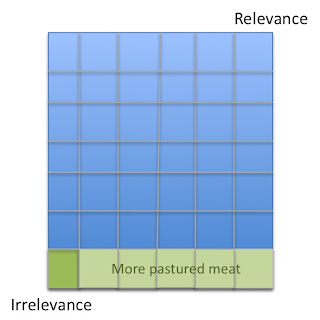
[Turning an economically irrelevant annual gross farm income of $5,913 into $250,000 on a small farm just outside Melbourne]

The last post got us (somewhat shakily) from just over 3 tonnes of annual meat production to 20 tonnes.  I divided up the increase into that coming from better pastures, that coming from better pasture management, some fodder cropping and fodder purchases and, finally, by integrating Moora with some other currently unproductive rural land.  Reflecting on it since ...  I think it can be done.

So here's how we start episode 2.

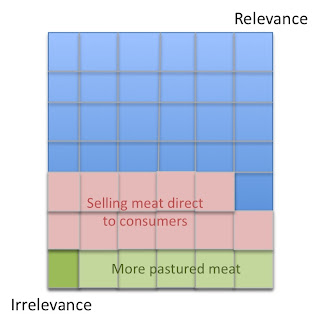
The next step to relevance has to be how we sell the meat.  This year I had a couple of steers that we'd grown - and a butch heifer that had failed to get in calf twice.  We sent them to the saleyards at Kyneton on a cold July day when there was not a lot available - and we got $1-80 kg live weight for the steers and a little less for the heifer.  

As it happens, that was considered a pretty good price.  But I had no idea when I consigned the stock what sort of yarding there would be.  I knew my animals were in good knick - and should eat well, but with me in Jakarta, I couldn't really bring them home if the prices were depressed that day.  I was the classic price taker. 

Farmers tend to be price takers almost all the time.  It's a tough position to be in - when buyers are supposed to be on a level playing field, but are not.  

Now let's get one thing clear - I believe (deeply, passionately) in markets as the most efficient way of allocating things to their best use.  But I also know that perfect markets exist only only in economics text books.  

I also think our food markets are about as screwed up as its possible to get.  How and why this has happened is coming to be understood and, on one level, I'm interested in righting the wrongs, but I'm also aware that if I wait for the world to work 'fairly', I'll be waiting a long time.

I think the task is more to understand the way the system works and then attack the seams (as the old basketball coach used to say).  Every system has it's weaknesses - including the food system.

When I sell at the Kyneton market, I'm feeding my meat into the industrial food system.  I shouldn't be surprised when I get a low price.  So I've got to find a way to sell my meat to consumers and dis-intermediate as much of the industrial agriculture / supermarket system as I can.

I think I'm fortunate in that the current system is now staggering under the weight of its own internal contradictions.  Hell - we're fortunate because supermarkets deliver a fair bit of crappy food - including food that flat out makes us sick.

So I suspect the timing is right to look for ways of taking my 20 tonnes directly to the consumer.  If I can do that, I've got 2 sources of income uplift: 
  • first the difference between the wholesale price of live stock and the current retail price of meat; and 
  • then there is the change in the price of agricultural produce that will occur as industrial agriculture collapses under the weight of it's own contradictions.
I happen to think the collapse is already underway, but for the purposes of this challenge I'll limit myself to the uplift available from selling to end consumers at current retail prices.  

I'm still learning about this, but  it seems that beef dressing out percentages are generally in the mid 50s and lamb in the low fifties.  Overall I think it's reasonable to expect around 11 tonnes of saleable meat from 20 tonnes live weight.

Then there is the question of price.  Rutherglen Lamb (a great product / service  www.rutherglenlamb.com.ausell a lamb for $220 and guarantee a minimum 12 kg.  That highlights a second level of yield where parts of a carcasse can't be easily sold - these lambs will have started at about 42 kg, dressed out at (say) 22 kg and ended up as (say) 15 kg in the lamb pack.  

I'm going to take a guess and say that at the retail level $1-80 a kg live weight becomes $5-00.  This is just a bit less than the Rutherglen lamb ($220 / 42 live weight = $5-23).  Lamb tends to be higher priced than beef - but the $5-23 takes no account of value in by products.  Anyway - let's go with $5-00 / kg.

The addition then is $5-00 - $1-80 = $3-20 * 20 tonnes = $64,000.  That's an extra 11 squares filled in.

Thursday, January 8, 2009

Visiting with the bull


While we were home we brought the bull we share with another Galloway breeder back to Moora and put him in with the cows. 

I remember as a (perhaps) 10 year old asking my dairy farming Uncle Richard how he knew when it was time for his cows to pay a visit to the bull paddock.  His answer was "they wink at me".

Beef cattle are easier - you just put the bull in and leave him there for long enough for at least a couple of cycles. 

They (the cows) know when the time is right however.  Last week while fencing truffles I could see Glenblairie Victorious 1st pressing his attentions on one of the cows that (it seemed) was not quite ready.  An awful lot of energy was wasted.  Perhaps she just objected to the human audience?


Tuesday, December 23, 2008

Back home


Hey - it's good to be home.  

We flew back from Jakarta overnight Thursday.  It's now Monday evening and it seems like we've been here a while.  The farm looks good - particularly because of the 100 mm of rain about a week ago.  

We got the cattle in yesterday.  We weighed them, applied NLIS tags to those who didn't have them, and drenched them.  The photo shows Te Papa Henny objecting to having her head held so we could put the tag in.  Generally, they look to be in great condition with the cows ready to go to the bull.  A January conception will give an October calving.  Tomorrow we will take some young heifers and steers to a friend's farm, bring back some cows - and collect the bull from his co-owner.  It will be another big day.

We have a building project going on - so quite a bit of time has been put into understanding where things are up to, taking some of the little (and big) decisions that need to be taken - and just tidying up.  This is actually the 3rd time we've done a significant building project.  The team we have this time feels pretty good.  

I haven't been able to convince son Neil of the soothing effect of time on the big ride-on mower.  Fortunately the farm manager did one mow a couple of weeks ago.  Consequently only a few hours of effort with mower and brush cutter, and the place looks spick and span.


Wednesday, December 17, 2008

Cattle


The prettiest part of Moora may not be the stone walls.

We have (just checked) 24 Belted Galloway cattle.  We bought our first cow about 5 years ago and have gradually increased the herd size. 

They are lovely quiet animals - and, I'm told, produce great beef.  So far I've kept the heifers and sent the steers to the market, but in time we want grass fed, local Moora beef to be one of our core products.

In two days we'll be on our way back to Australia for Christmas.  

Next week we have a big day planned.  We will get the whole herd in and check them out - tag some that need a tag - and separate out the young heifers that are old enough to cycle, but too young to go to the bull.  They will then take a trip to our friends' place.  Allan and Sandy have a place at Romsey and agist some of our stock for us.  They presently have 3 cows and calves that will have to come back to Moora.

We will then go and get the bull from Mick's place.  The bull will then go in with the cows for about 3 months.  That gives time for the cows to cycle several times - and, hopefully, all get pregnant.

It will be a big day - but one we're looking forward to.