Showing posts with label Chooks / eggs. Show all posts

Friday, March 30, 2012

Chicken update

S
We're back in the egg business.

We had given up last year after the foxes got the better of us - more particularly of our chooks.  In the end they got the lot.

That is the reason we got the Maremmas - see earlier posts.  We started them each with their own small flock of sheep.  As they got a little older we saw the opportunity (as we always intended) to get back into chooks.

Because we are a bit 'gun shy' at this stage we decided to limit our investment by getting some ex battery hens.  I think they're only about a year old.  The man who supplied them said he'd picked out 'the best of them' - and that the shock of being shifted would mean they probably wouldn't lay for a while.

We got 12 eggs from 22 chooks the first day!

They were pretty scruffy when they arrived - not a lot of feathers.  I hate to think what 'the worst of them' must have looked like.

There is a big difference already in this photo - which was taken a couple of weeks after they came.  Tell me these girls aren't happy!  Happy enough to producing an egg each pretty much every day.

As soon as they arrived we put Polo (one of the Maremmas) beside them in a pen made of 5 farm gates.  We then started carefully supervised contact with the chooks - with Polo always on a lead.  Left to himself he wanted to play - except he's 35 kg (and growing) and they are not.

However, I got back from an overseas trip yesterday and - hey - Polo has 'graduated' to being a fully fledged livestock guardian dog.

There he was lying in the shade with chooks all around him.  This photo has him with one of the two that still look a bit scruffy.  The rest a just about as good as new.

I noticed last night that he was barking a bit.  The chooks were locked up, but he's letting any foxes know that he's around.  I'll put up with a bit of barking if I know the chooks are safe.

Polo is still only about 8 months old.  The book says they are not completely reliable until at least 18 months - so we'll keep a close eye on him.

This is a fantastic development though - as we can now think about getting more hens and having more eggs for sale.  And the production we've been getting from the ex battery girls is good enough that they seem to be a better deal at $2-50 / bird than getting point of lay pullets at nearly $20.

We've put a sign at the gate offering free range eggs.  The boss priced them at $5 / dozen without consulting the accountant.  I think they're worth more than that.

My mind is now turning to a Chookmobile V2.0.  The next one will be bigger and enable us to have more chooks - and to follow the cattle.  This is a system developed by Joel Salatin - whereby the chooks act as what he calls his 'sanitation crew'. 

His mobile henhouse follows about 4 days behind his cell grazing cattle.  He says this is just time enough for flies to lay their eggs and for the larvae to hatch - but not enough time for them to pupate and produce the next generation of flies.  The chooks dig their way through the cow pats looking for larvae (maggots) - and, in the process, spread the cow pat about.

This provides quick return to the soil of the nitrogen and organic matter in the cow manure - and, of course, the hens add their own concentrated nitrogen boost.

I already spread a certain amount of chicken manure that I get from a farm over near Riddells Creek.  I was looking yesterday at two parts of my paddock 43 - one half has had chicken manure and other hasn't.  There is quite a difference.
F

Saturday, August 27, 2011

What's going on ...

S
Haven't blogged for a while - so here are some photos of recent goings on as we head into Spring.

 Spring means new arrivals.  This little sweetheart looks as though her mother had a fling with a Friesian bull.

The cows are now in a separate paddock and clear of last years calves.  Sometime in the next month they'll be looking after new ones.

The second photo shows my daughter in law learning a useful skill.  Elastrator rubber rings are part of family history - with both my grandmother's brother and Kristina's grandfather part of patenting the idea.  They went on to sell a lot of them!

Doing the tail is easy enough, but the castration task needs care.

Not much fun for the lambs, but then ... I didn't enjoy being vaccinated when I was a little tacker.  They lie around for half an hour, but are then up and running again.
 
The first of our Maremma pups is now at Moora.  We've called him Polo - which is short for Napoleon - and the other one is likely to be called Josephine .... Josie perhaps.

He seems like a very bright little thing.  As gorgeous as any other pup, but showing signs of being suited for the work he has to do.

We are gradually getting him used to (and bonded to) the animals he has to protect.  Each day we take him on 2 or 3 walks around the area he has to watch most closely.  At least one of the walks is on a lead.  He didn't like it the first couple of times, but accepts it now.

He is already in the paddock - and isn't allowed near the house.  He has a kennel.  The first night I wasn't sure whether he had worked out where to sleep, but he has now.  The other problem is that it is not going to be big enough for him for very long.  The gates keep him from playing with the chooks - at the moment his only contact with them is supervised.

We've all reading a book produced by a scientist at the Cooperative Research Centre for Invasive Animals.  It's a very useful document.
F

Monday, August 8, 2011

Problems ...... and solutions

S
Last week we were late locking up the chooks ...... and lost 8 in one night.  With the 3 lost while we were away and a couple of other single losses, our small start to egg production has been brought to a shuddering and distressing halt.  Not that we've seen them, but it has to be foxes.

The loss of these birds hurts us financially - they cost money to buy - and we have also lost the income we were earning from the sale of eggs.  But the sense of having failed our livestock hurts worse.  It is said by farmers that where there are livestock there will be dead stock, but we still owe them the best care we can manage.  And that includes remembering to lock them up before nightfall.

On Saturday morning we took a step towards solving the problem.  We put a deposit on 2 Maremma pups.

Maremmas are a livestock guardian dog - originally from Italy.  One of our pups is 4 weeks old - and the other 6 weeks old.  This is the younger one.

We will bring them home at 8 to 10 weeks just as they are weaned.  They will then begin their training immediately.  I have found a book that describes itself as a Best Practise Manual for the Use of Guardian Dogs.  The author worked in an Australian research institute and our breeder said "She got a few things wrong, but not many."  Sounds like a recommendation.

One of our dogs will be put with the remaining 3 chooks - to bond with them.  The other will be put with a couple of the quieter ewes and their new lambs.  We have to make sure they spend time with the animals they are to bond with, but have somewhere to get away from them, and not be allowed to play with them.  Sounds like a lot for a pup, but 'the book' says 8 weeks is the best time to start.

Once we have the chook pup trained well enough - and only then - will we get another batch of hens.  This will take several months at least. 

Thursday, June 30, 2011

Four farms - No.1

S
Over the last 5 or 6 days we have visited 4 farms - one twice.  Each has been special in its own way.  I'll do a post on each over the next few days.

Number one was Eliot Coleman's Four Seasons Farm in  Harborside, Maine (Sic - it's Americans who can't spell harbour - not me).  This is a very special farm - growing vegetables mainly - in a quite inhospitable climate.  Coleman has made a specialty of growing vegetables using poly tunnels and a lot of smarts.   

The attention to detail was obvious.   Everything was very tidy - just sort of obsessively so perhaps.  There were so many things I was interested in - from the hand carts to his trellising system to the heating system in the poly tunnels - to the chicken tractors.  

James the Trailer Doctor is going to have some things to make for me.  The cart in particular is quite similar to one we used to have on the farm when I was growing up.  We called it the U-cart.  The American version is called a Vermont Cart.


Eliot's version was particularly stylish.  It is so much better than a wheelbarrow - for everything except concrete.  

I actually hate wheelbarrows - I've skinned my shins on on the cross bar too many times.  They all have handles too short for someone my height.

The second thing I really liked was the chicken trailer.  It's not quite so obvious that I'll get one built, but I like the lightness of it, the perches at floor height, the mesh floor and the integrated next boxes. 

Four Seasons Farm has a farm shop and also sells through farmers' markets.  People from the area say the prices are high, but the quality is brilliant.  I bought some fennel, baby leeks, white onions, carrots and zucchini and grilled them as an accompaniment to a nice piece of sirloin.  They were very good - in spite of a bit of a scorching.

Four Seasons Farm seems to employ 'interns' - who work for a period to learn - and then go off to start their own farms.  Cheap and motivated labour.  Other farms we visited seem to also use this system.  Not only is it difficult for a farmer to earn a living wage rate - it seems to be hard to pay for help.

Overall ..... very impressive!
F 

Saturday, December 25, 2010

The Chookmobile

S
A couple of months ago I managed to pick up an  ancient box trailer at a clearing sale for $100.  It was pretty rickety, but had a light structure on top of a reasonable axle with 2 good wheels and tyres (and a couple of spares).  The tow hitch was broken - as was most of the bracing - so it was brought home (only 3 km) very carefully.

I knew right from the start what I wanted to do with it.  I wanted a mobile chicken house for up to 50 laying chooks.  I bought a set of nest boxes and got James the Trailer Doctor on the job.  What came back is a work of art.

Here are photos - first from the rear and then the front.  James made a structure to fit over and around the existing box.  It supports a new roof and a fox-proof back door.

On each of the rear corners James has added a 'leg' that means farmers of over 100kg can, at a pinch, get inside without overturning the whole enterprise.

Inside I have added enough perch space for at least 30 birds, a waterer and a feeder.  I've put cardboard on the floor held down with staples.  When it comes to to clean it out, hopefully, most of the mess will come out with the cardboard to go straight into the compost heap.

From the front you can see the jockey wheel and how James has fitted the nests.  They are commercial ones with a rollaway egg collection system accessible from the outside.

We took the Chookmobile straight into the Trufferie where they have a confining fence - as well as being locked away at night.  In time we may also get a Maremma dog for further fox and dog protection.

The whole thing tows easily behind our Polaris Ranger.

The point of this is that a mobile chook house avoids the concentration of scratching and manure deposition that happens around a permanent structure.  Not only can we move the Chookmobile around the Trufferie, but we can take it anywhere else on the farm.  In addition, a grazing bird can get a reasonable proportion of her feed from pasture and the critters she finds as she scratches.  Not to mention the fertility that gets spread around.

We started with a borrowed rooster and 4 black hens as Chookmobile testers - and they settled in quickly.  Yesterday we bought 10 Isa Brown hens as the start of our own flock.  They are as beautiful (and interesting) as chooks are everywhere.
F

Tuesday, February 3, 2009

Economic relevance - episode 4

[Turning an economically irrelevant gross farm income of $5,913 into $250,000 on a small farm just outside Melbourne]

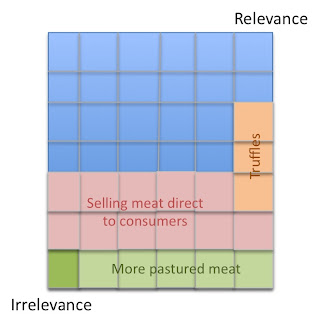
Permaculture has several design principles that are aimed at multiple sources of output from the same piece of land.  It talks about polycultures, about stack
ing and layering, and permaculture guilds.  

There is certainly no way we can achieve our income objective without applying such techniques.  

Episode 4 is going to be about a type of livestock that I'm hoping is almost completely complementary to our cattle and sheep.  By complementary I mean that it will add output - without detracting from the capacity to produce other outputs.

My Granny always had chooks - and not the 20 or 30 that my Mum kept.  Granny had hundreds and she was very fond of them.  When I think about it, my Aunty Marg also had chooks - because I can remember collecting eggs and cleaning them for her while she was away on holiday.

However, the model we're going to work to at Moora comes from much further away - in the US.  Joel Salatin, who featured in The Omnivore's Dilemma, pastures poultry in a kind of symbiosis with his cattle.  

The cattle graze grass first - followed several days later by the laying hens - who appreciate the shorter grass and also demolish the cowpats to get at fly larvae that emerge after a few days.  Breaking up cowpats is a function that fussy farmers sometimes perform with a set of paddock harrows.  I've done it with a 4 wheel motorbike towing an old gate.  The result indeed looks tidy - but the grass also seems to 'take off' compared to the untreated paddock.

I've not actually seen maggots in cowpats, but I guess they have to be there.  Certainly we get more than enough flies in summer - and more near the cattle - and they have to come from somewhere.

So I'm thinking of building one (and then 2) mobile hen houses that will follow the cows around.  The chooks will be protected from foxes and dogs by an electric netting fence.  Salatin says that the grass they eat is more than compensated by their 'processing' of the cattle residue - and the addition of their own nitrogen rich manure.

While we were in the US at son David's graduation we stayed at a little B&B near Marietta, Ohio.  They had a Salatin type chicken tractor.  It's not what we'll build, but it's pretty - and reminds me of a good stay with Mike and Jackie.  When I think about it, Jackie was actually the first person to mention Salatin to me.  If you're ever in Little Hocking, Ohio and need a good place to stay .....

In the winter we will need to take them off the paddocks for a few months.  I'm thinking we'll winter them in a poly tunnel that we will use for growing hot house crops in the spring.

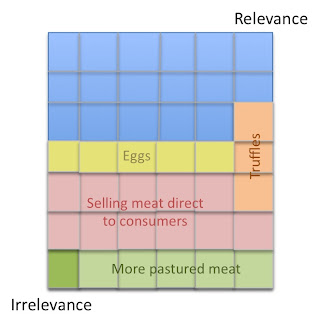
Let's say we work up to 2 flocks of 120 hens each.  Let's say they can produce 285 saleable eggs pa.  That is 5,700 dozen eggs.  At $5 / dozen that is $28,500.  

They only lay at that rate for a year - so we'll also have 240 birds a year to sell at next to nothing - or ... Joel Salatin suggests home killing and selling the cooked meat in some ready to eat form.  There is a bit of investigation to be done into this idea, but lets assume we can.  That might add another $1,500 - which is quite close to next to nothing ...

However, it adds up to another 5 squares to the cause.  

It's worth noting that this again assumes selling directly to consumers.  Selling into the industrial system would produce, I suspect, less than a third as much.  5,700 dozen is a somewhat intimidating number to have to move, but clearly necessary if we're to get to our goal.