

 Posts
Posts


S
A large retailer is reported today to have 'imposed' a 5 % cut on prices paid to suppliers for a 3 month period as an 'investment of mutual benefit to both our organisations'.
This is Orwellian.
If a consumer walked out of their store with 5% more than they had paid for, presumably they would want it to be called theft rather than a 'mutual investment'.
A farmer in the industrial system has to deal with these people. Even a farmer outside the industrial system has to deal with the consequences of consumers having access to product derived from exploitative systems.
People in the city should understand the level of abuse and economic distortion that underlies their access to 'cheapness'. These things don't last forever.
F
Showing posts with label Industrial food. Show all posts
Showing posts with label Industrial food. Show all posts
Tuesday, September 27, 2011

Thursday, July 21, 2011
Everything dies
S
The last few weeks has seen the Indonesian live cattle scandal explode and expire.
I think the main problem exposed by this affair is the disconnection most Australians have from animal reality - and the willingness of foolish bureaucrats and politicians to pander to nonsense - to the fairly immediate detriment of animals, farmers and common sense.
Let's get one thing clear at the start. I don't think it's ever a good idea for humans to mistreat animals. But it's an ill (at the extreme perhaps - an evil) just like a lots of other ills. We need to be careful that we don't turn our world upside down to solve one ill - at the cost of creating a series of other ills - worse than what we started with.
Let's remember that a domesticated cow is descended from what was always a prey animal. Its ancestors were chased, caught and killed by predators for millions of years - with nary a stun gun in sight. Cattle or sheep or chickens having a scary, gory, painful end is what they have always had.
When we kill domesticated (or other) animals 'humanely' we are doing it, I think, for two reasons:
My father and mother couldn't afford to be squeamish if they wanted to have the treat of what they then called 'poultry'. Between them, they had to kill a hen, pluck it, gut it, clean it, prepare it. Their grandchildren pick up the organic chicken from the supermarket or Deli - and just have to cook it.
The reality is that the life (and end) of the hen my parents put on our table in the 1960s was immeasurably better than that of the chicken my kids eat. Eight week life, unnatural food, unnatural housing, sub clinical dosing with antibiotics, grotesque body shapes, industrial slaughterhouses ... that's what produces the chicken we eat every day.
Sorry ... the organic chicken will have another week or two of life, slightly better food, slightly better housing, no antibiotics - and an industrial slaughterhouse.
I can't help but see the fuss over the way Indonesians treat cattle as ... mainly ... self indulgent (and hypocritical) squeamishness in a set of circumstances where the very real costs of that self indulgence are imposed on others.
[After discussing the following two paragraphs with my cultural adviser (my son), I've decided to add a warning. Only read on if you have heard of DH Lawrence.]
I'm reminded of the line in Lady Chatterley's Lover where Mellors observes to Connie (her in a state of undress) "An' if tha shits an' if tha pisses, I'm glad. I don't want a woman as couldna shit nor piss."
Mellors was enough in touch with reality to understand that humans (and animals) shit, piss ... and, one day, die.
F
The last few weeks has seen the Indonesian live cattle scandal explode and expire.
I think the main problem exposed by this affair is the disconnection most Australians have from animal reality - and the willingness of foolish bureaucrats and politicians to pander to nonsense - to the fairly immediate detriment of animals, farmers and common sense.
Let's get one thing clear at the start. I don't think it's ever a good idea for humans to mistreat animals. But it's an ill (at the extreme perhaps - an evil) just like a lots of other ills. We need to be careful that we don't turn our world upside down to solve one ill - at the cost of creating a series of other ills - worse than what we started with.
Let's remember that a domesticated cow is descended from what was always a prey animal. Its ancestors were chased, caught and killed by predators for millions of years - with nary a stun gun in sight. Cattle or sheep or chickens having a scary, gory, painful end is what they have always had.
When we kill domesticated (or other) animals 'humanely' we are doing it, I think, for two reasons:
- the meat of an animal that was not stressed at the time of slaughter tastes better; and
- in some way we (humans) are always diminished by cruelty.
My father and mother couldn't afford to be squeamish if they wanted to have the treat of what they then called 'poultry'. Between them, they had to kill a hen, pluck it, gut it, clean it, prepare it. Their grandchildren pick up the organic chicken from the supermarket or Deli - and just have to cook it.
The reality is that the life (and end) of the hen my parents put on our table in the 1960s was immeasurably better than that of the chicken my kids eat. Eight week life, unnatural food, unnatural housing, sub clinical dosing with antibiotics, grotesque body shapes, industrial slaughterhouses ... that's what produces the chicken we eat every day.
Sorry ... the organic chicken will have another week or two of life, slightly better food, slightly better housing, no antibiotics - and an industrial slaughterhouse.
I can't help but see the fuss over the way Indonesians treat cattle as ... mainly ... self indulgent (and hypocritical) squeamishness in a set of circumstances where the very real costs of that self indulgence are imposed on others.
[After discussing the following two paragraphs with my cultural adviser (my son), I've decided to add a warning. Only read on if you have heard of DH Lawrence.]
I'm reminded of the line in Lady Chatterley's Lover where Mellors observes to Connie (her in a state of undress) "An' if tha shits an' if tha pisses, I'm glad. I don't want a woman as couldna shit nor piss."
Mellors was enough in touch with reality to understand that humans (and animals) shit, piss ... and, one day, die.
F
Sunday, January 30, 2011
Nothing more to be said
F
Here is an article on why you should buy food from someone you know and, as much as possible, avoid buying 'cheap food' from a system that systematically abuses both its suppliers and customers.
F
Here is an article on why you should buy food from someone you know and, as much as possible, avoid buying 'cheap food' from a system that systematically abuses both its suppliers and customers.
F
Sunday, January 23, 2011
Coles and Growth Hormones
S
There is a big story running in Australian papers about how Coles (one half of the grocery oligopoly) is going 'hormone free' with it's beef.
Notice that the quote attributed to Curtis Stone says 'all the fresh beef'. What about the rest?
And try to guess who might have pressured their 'supply chain' into production systems that 'depend' on things like growth promoting hormones and antibiotics in the first place?
Supermarkets seem to me a bit like miners - except they don't do the remediation that even strip miners are now required to do as a condition of their licensing. Supermarkets are only 'cheap' because they have created a system that reduces costs that people pay at the checkout while driving costs people pay through other means.
They 'mine' their supply chains for 'efficiencies' that are only efficiencies if you ignore costs of land degradation and social dislocation caused by industrial agricultural systems.
They jam the health system with people sick from eating the food they sell.
They use advertising and lobbying to create a world in which 'cheap food' is an political necessity. Reality check! No one in human history has spent a lesser proportion of their income on food that the modern consumer!
We don't need cheap food. We need (as we always have) good food and systems that produce it reliably.
I don't like the idea of growth hormones or, more particularly, farming systems that make it necessary for animals to be fed drugs we don't fully understand. But Coles should get no credit for doing this. They should get condemnation for:
- hedging on products containing processed beef; and
- jerking around their suppliers - after encouraging them into such counter-productive systems in the first place.
In the end supermarkets are not sustainable - and some of us are more exposed to their unsustainability than others.
F
There is a big story running in Australian papers about how Coles (one half of the grocery oligopoly) is going 'hormone free' with it's beef.
Notice that the quote attributed to Curtis Stone says 'all the fresh beef'. What about the rest?
And try to guess who might have pressured their 'supply chain' into production systems that 'depend' on things like growth promoting hormones and antibiotics in the first place?
Supermarkets seem to me a bit like miners - except they don't do the remediation that even strip miners are now required to do as a condition of their licensing. Supermarkets are only 'cheap' because they have created a system that reduces costs that people pay at the checkout while driving costs people pay through other means.
They 'mine' their supply chains for 'efficiencies' that are only efficiencies if you ignore costs of land degradation and social dislocation caused by industrial agricultural systems.
They jam the health system with people sick from eating the food they sell.
They use advertising and lobbying to create a world in which 'cheap food' is an political necessity. Reality check! No one in human history has spent a lesser proportion of their income on food that the modern consumer!
We don't need cheap food. We need (as we always have) good food and systems that produce it reliably.
I don't like the idea of growth hormones or, more particularly, farming systems that make it necessary for animals to be fed drugs we don't fully understand. But Coles should get no credit for doing this. They should get condemnation for:
- hedging on products containing processed beef; and
- jerking around their suppliers - after encouraging them into such counter-productive systems in the first place.
In the end supermarkets are not sustainable - and some of us are more exposed to their unsustainability than others.
F
Sunday, October 17, 2010
Cross subsidies
S
I just watched this week's Landline program. It had 3 stories where there was a Bush / City conflict of significant dimension. No surprise ... the Bush is losing every one. I felt a lot of sympathy for:
I've been part of a world view that believes good pricing generally leads to good outcomes. I don't use the word 'efficient' as an economist would, but I mean many of the same things. This world view has, unfortunately, been a significant part of screwing the Bush blind for, at least, several decades.
Good pricing means people see the real price of things over the medium term. What I would term real prices are something between short run and long run marginal cost - with the excess distributed with some sort of equity.
Far too often over the last 30 years, the Bush sees too little equity - and precious little common sense besides. It has to sell into markets where it faces systemic (but usually) unacknowledged market power, but then faces heavy access and price discrimination on their inputs.
We should recall that Australia is built, right back to white settlement, on agriculture and mining. These are pretty much the only things we have ever produced on a consistently, globally competitive basis. Miners seem to be big enough to look after themselves, but for at least 50 years farmers have lacked the capacity to get a fair share.
I'm a bit sensitive to this point partly because of a conversation I had with a colleague last week. We were talking about my likely access to the benefits of the NBN - 50 km from the centre of Melbourne and 5 km from a reasonably substantial town. No fibre for me! Apparently I will likely (possibly) get access to the internet at 12 MB / sec (as against my current 0.16 MB / sec). My City (and town) friends are going to get 1 TB / sec via their fibre!
When I complained, my colleague looked at me with a resigned look that said I should be grateful of getting anything - and didn't I understand that I was just paying what it cost.
I've made a mental note to sell him some very expensive food if his food distribution system ever breaks down and he turns up at my gate.
I don't actually think the answer lies very much in any sort of political action. Farmers / rural people are just too few to ever win that way. People treat people like Bob Katter as a clown - when he is actually saying some things that are no more unreasonable than the rubbish my colleague thinks of as perfectly ok.
To me the answer has to be a market one - where we just don't sell through the industrial / supermarket system that has served us so poorly, but create parallel distribution channels that dis-intermediate food processors and supermarkets like they dis-intermediated the wholesale / retail system that used to serve producers a bit more equitably.
It may be that peak oil or other developments turns things in our direction at some stage. I don't really know that I hope for that. Another story on Landline was about the Bowen poisonings of the water of a tomato nursery. That nursery apparently supplied farms that produce (at least at certain times of the year) some 60% of Australia's tomatoes.
The poor sods directly affected by this I feel sorry for. The punters in the City who get to miss out on their tomatoes - or have to pay more for them - I feel somewhat less sympathy for.
E
I just watched this week's Landline program. It had 3 stories where there was a Bush / City conflict of significant dimension. No surprise ... the Bush is losing every one. I felt a lot of sympathy for:
- small scale timber mills producing hardwood sleepers and the like who are being driven out of business by a combination of big mills, imports and environmentalists;
- aboriginal and other people adversely affected by Queensland's Wild Rivers legislation; and
- Murray Darling irrigation towns who want some recognition of the consequences of water reallocation proposals.
I've been part of a world view that believes good pricing generally leads to good outcomes. I don't use the word 'efficient' as an economist would, but I mean many of the same things. This world view has, unfortunately, been a significant part of screwing the Bush blind for, at least, several decades.
Good pricing means people see the real price of things over the medium term. What I would term real prices are something between short run and long run marginal cost - with the excess distributed with some sort of equity.
Far too often over the last 30 years, the Bush sees too little equity - and precious little common sense besides. It has to sell into markets where it faces systemic (but usually) unacknowledged market power, but then faces heavy access and price discrimination on their inputs.
We should recall that Australia is built, right back to white settlement, on agriculture and mining. These are pretty much the only things we have ever produced on a consistently, globally competitive basis. Miners seem to be big enough to look after themselves, but for at least 50 years farmers have lacked the capacity to get a fair share.
I'm a bit sensitive to this point partly because of a conversation I had with a colleague last week. We were talking about my likely access to the benefits of the NBN - 50 km from the centre of Melbourne and 5 km from a reasonably substantial town. No fibre for me! Apparently I will likely (possibly) get access to the internet at 12 MB / sec (as against my current 0.16 MB / sec). My City (and town) friends are going to get 1 TB / sec via their fibre!
When I complained, my colleague looked at me with a resigned look that said I should be grateful of getting anything - and didn't I understand that I was just paying what it cost.
I've made a mental note to sell him some very expensive food if his food distribution system ever breaks down and he turns up at my gate.
I don't actually think the answer lies very much in any sort of political action. Farmers / rural people are just too few to ever win that way. People treat people like Bob Katter as a clown - when he is actually saying some things that are no more unreasonable than the rubbish my colleague thinks of as perfectly ok.
To me the answer has to be a market one - where we just don't sell through the industrial / supermarket system that has served us so poorly, but create parallel distribution channels that dis-intermediate food processors and supermarkets like they dis-intermediated the wholesale / retail system that used to serve producers a bit more equitably.
It may be that peak oil or other developments turns things in our direction at some stage. I don't really know that I hope for that. Another story on Landline was about the Bowen poisonings of the water of a tomato nursery. That nursery apparently supplied farms that produce (at least at certain times of the year) some 60% of Australia's tomatoes.
The poor sods directly affected by this I feel sorry for. The punters in the City who get to miss out on their tomatoes - or have to pay more for them - I feel somewhat less sympathy for.
E
S
Sunday, August 23, 2009
I want to be a peasant
I've always found it amusing that, in many countries, being a farmer is thought of as pretty low status - particularly if one is a small farmer - or peasant. This is not the way farmers were thought of in New Zealand or Australia when I was growing up. Having internalised that way of looking at the world, I could never really see the growing of food as anything but an honorable and important calling.
So it's refreshing to discover an organisation called La Via Campisena which sub-titles itself the International Peasant Movement. They're big on food sovereignty and very negative on the WTO, World Bank, IMF et al.
However, I'm not sure we get to quite similar positions on the same basis. I think I get there more like Joseph Stiglitz - who said it well in Globalisation and Its Discontents:
Behind the free market ideology there is a model, often attributed to Adam Smith, which argues that market forces--the profit motive--drive the economy to efficient outcomes as if by an invisible hand. One of the great achievements of modern economics is to show the sense in which, and the conditions under which, Smith's conclusion is correct. It turns out that these conditions are highly restrictive. Indeed, more recent advances in economic theory --ironically occurring precisely during the period of the most relentless pursuit of the Washington Consensus policies--have shown that whenever information is imperfect and markets incomplete, which is to say always, and especially in developing countries, then the invisible hand works most imperfectly. Significantly, there are desirable government interventions which, in principle, can improve upon the efficiency of the market. These restrictions on the conditions under which markets result in efficiency are important--many of the key activities of government can be understood as responses to the resulting market failures.
Like Stiglitz, I see the failure of the World Bank, IMF and WTO as deriving not from evil conspiracy, but from a series of intellectual errors and a bureaucratic failure of the imagination. What ever they intend, they end up serving the interests of first world corporations (particularly the finance sector) against any sensible conception of the public interest. And these corporations (mainly) follow the rules - except the rules are dumb - particularly in systematically favouring scale - and then in allowing scale to distort markets.
In the late 90s and early this decade I watched Australian regulators completely muck up the implementation of independent economic regulation of the electricity and gas sectors. There were a couple of sensible, pragmatic characters (in NSW and SA), but the rest were hopeless. They cloaked themselves in the public interest and ended up doing the devil's business - because they didn't have much idea about how the real world actually works.
But when things go wrong (and plenty of things are wrong with the world), it's almost always because the we have screwed up. The implication of this is that it is only we who can actually change anything - not they or them - just we.
These things I believe !
So I've decided the practical, rational response to all the problems of the food system is ...... for me to be a peasant. Not long now .....
Sunday, August 9, 2009
Bush fires
I've been looking at submissions to the Bushfires Royal Commission.
There is one from the Australian Forest Growers that makes a lot of sense. The person who wrote it is measured and careful, but the recipe for disaster comes through:
Psuedo science + Politics + Bureaucratic caution = Disaster
This recipe for disaster afflicts us in multiple spheres. To avoid the charge that I'm either right wing - or left wing - let me use three examples side by side (and try to offend everyone equally).
In each case there are alternatives to the psuedo science that has come to dominate the politics - but we've exercised our democratic choices or allowed stakeholder manipulation of our democratic choices - to the point of disaster. Bureaucrats follow the politics - as, to a degree, they must.
In each case the system turns out to be more complex than we though - ahhh - complex systems again.
There is one from the Australian Forest Growers that makes a lot of sense. The person who wrote it is measured and careful, but the recipe for disaster comes through:
Psuedo science + Politics + Bureaucratic caution = Disaster
This recipe for disaster afflicts us in multiple spheres. To avoid the charge that I'm either right wing - or left wing - let me use three examples side by side (and try to offend everyone equally).
Example disasters | ||
Victorian bushfires | Industrial food | Global financial crisis |
Underlying ‘pseudo’ science | ||
Environmental sciences | High input, industrial agriculture | Modern finance and risk management theory |
Politics | ||
The green vote | Cheap food | Too big to fail |
Bureaucratic failure | ||
Inaction on fuel reduction | Skewing of the regulatory system in favour of industrial food | Deregulation and self regulation of financial sector |
Result | ||
Fuel build-up leading to catastrophic fires | Local food systems are disadvantaged by an excess of caution while industrial food systems are subsidised and their externalities socialised | The profits of excessive risk taking are ‘earned’ by the finance sector – while the inevitable losses are socialised |
In each case there are alternatives to the psuedo science that has come to dominate the politics - but we've exercised our democratic choices or allowed stakeholder manipulation of our democratic choices - to the point of disaster. Bureaucrats follow the politics - as, to a degree, they must.
In each case the system turns out to be more complex than we though - ahhh - complex systems again.
Saturday, June 13, 2009
Pointless hyperbole
One of my dear sons was with me in Jakarta this week while his mother was galavanting around Eastern Indonesia on a luxury yacht. While my wife is not prone to hyperbolic excess, most 26 year old sons are on occasion.
The thing that irritated me was his use of the vegetarian slogan 'meat is murder' - and then his attempt to defend his use of such a silly perjorative. He's not even a vegetarian himself - and he was dining on waygu beef at the time. It encouraged me to thing of my own equally stupid, but actually more accurate, slogan - 'vegetarianism is genocide'.
Murder is the unlawful taking of a human life with malice aforethought. How this applies to eating meat I'm not quite sure. I have no objection to someone saying 'some (or even most) meat involves a level of mis-treatment of animals that I want no part of'. I don't mind (though I don't understand) someone deciding they are so uncomfortable with slaughtering any animal, that they will, themselves refrain from eating meat.
But I object to anyone seeking to make any version of vegetarianism obligatory or holding out that it is superior - morally or in any other way.
For those so tempted, I'd like to introduce you to a couple of my calves and their mothers and note that these beautiful animals would simply not exist if we did not eat meat.

They wouldn't exist because they are the result of centuries of human selection for human meat consumption.
The little Dun calf is a heifer and, provided she produces healthy calves without too much drama, she can look forward to as many as 15 years at Moora. Her mate, then a bull now a steer, will be grown to somewhere between 2 and 3 years of age, when he will be slaughtered for meat. We will give each of them the best life (and death for that matter) we can - not only because we respect all animals, but also because it's the sensible thing to do as a farmer.
If the veggie-nazis were to win the argument, these animals would lose their economic value and, eventually, would simply cease to exist. Were I given to hyperbole (which I'm not) I might accuse them (the veggie-nazis) of genocide!
Two things I would clearly note about my own world view: I don't think many factory farming systems are an acceptable way to produce meat - and the amount of meat in an average Australian diet is probably excessive. I think it's very important to dismantle the 'protection' that factory farming has built up for its way of doing things, but I am not so sure that specifying ideal diets has ever resulted in anything very positive.
A couple of years ago I leaned over a gate at Moora with one of my dairy farming uncles. We were watching a very young calf feeding for the first (or maybe the second) time. My uncle, who must have seen in excess of 10,000 similar little calves, clearly had not grown immune to the simple pleasure of quietly watching over a young animal and talking with me about how best to take care of them.
Farmers are murderers ?? You've got to be kidding!
Monday, March 9, 2009
Economic relevance - episode 6

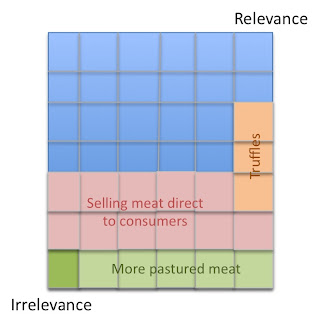
There are now only 7 boxes to go - at $5,000 a box that's $35,000 of my artificially set $250,000 of gross farm revenue. To remind readers - that's what I've defined as economic relevance for our 57 acre small farm.
We've got to $215k with a combination of pastured meat, truffles, eggs and a vegetable CSA. The businessman in me already says 'too much, too much' - in terms of too many things to focus on and get right. On the other hand, industrial agriculture is arguably the mess it is because of focussing in on monocultures and scale - and optimising things past the point of sustainability.
You can look at where we've reached as having several parts:
- two substantial production activities - pastured meat and vegetables;
- two smaller production activities - eggs and truffles;
- a need to process what we grow and present it in a marketable form; and
- a marketing system.
I think that's enough to start with - and also enough to be coherent and sustainable if we manage to do it well. So I'm happy to put the last $35,000 down to opportunities at the margin of what we plan to do. I can give some examples of where the dollars might come from:
- selling other people's produce through our marketing system;
- adding other mini crops as seasonal add ins - we already have an asparagus bed, we will plant walnuts and plums (chilli plum sauce). Just today we thought of establishing a big rhubarb patch - cooking apples go with that;
- selling some form of hospitality - which will have the benefit of bringing potential customers to the farm; and
- selling some form of education - which will also bring potential customers to the farm.

This sort of activity will be an essential part of re-localising food. Industrial agriculture deprives farmers of their connections to consumers and has pushed them towards being production specialists. Disconnected from the consumer and dealing with a few very large counter parties, it's hardly surprising that the farmers' share of the food dollar has contracted so far.

We enjoy people coming to the farm. We love the wide eyes of the kids - and the way parents relax. Thanks to Michael Pollan and others there is a growing awareness of the costs of industrial food. So, to some degree, we should be digging in fertile ground. And the advantage we have is - we don't need to convince everyone. In order to get to a $250,000 gross farm income, we're only looking for (say) 125 good, regular customers to buy an average of $2,000 worth of food each year.
Compared with other ways of grossing $250k, this still seems like very hard work. On the way through it's hard to imagine we haven't got $50,000 in direct off farm costs - and another (say) $20,000 in overheads (things like insurance, office costs and various registrations and fees). Then, in our 50s we can't expect to provide all the labour ourselves. Let's say we employ the equivalent of 2 full time people at a total employment cost of $40,000 each. We're now back to $100,000 to provide a return for our labour input - and our investment.
All I can say is - it's good that this something I want to do anyway - because it sure doesn't make sense against either of our day jobs!
I'm an accountant who was a partner in a major firm for 20 years. I haven't earned banker millions, but I have done well enough to qualify as a high income earner. The wife is a registered nurse. Nurses earn a good average wage - very good if the flexibility is taken into account. Neither nurses or even partners in big accounting firms are required to put in much in the way of investment in order to earn of incomes. In the main we turn up and work hard and smart - and that's enough.
It's not enough if you going farming - where we have to invest in our land - and in livestock, crops that don't return income for varying periods of time, machinery, fencing and other infrastructure.
This morning I caught something on Australian TV - it said that in 1950 you could buy a Holden car with what you could get for selling a single bale of wool. Today it takes 35 bales of wool to buy a Holden. Many things go into creating this sort of change in a farmer's terms of trade, but it has to be a sign of just how screwed up the system is. It's not like wool isn't still a valuable fibre.
I have just a suspicion that farmers' terrible terms of trade are going to start reversing - and perhaps have even started to reverse already. It is not why I want to go farming - but it is a part of why I can look at the relatively unpromising numbers I've set out above and still feel like I can't wait to get started!

Saturday, March 7, 2009
Economic relevance - episode 5
Last Monday was said to be the second worst day in terms of risk - after the terrible Saturday when the lives were lost. In mid afternoon a fire started about 10 km to the south west of our McKerrels tree farm. It is at Grenville 20 km south of Ballarat. The fire started in the worst possible place for us - just ahead of a south westerly wind change. Within an hour or two it had been 'controlled'. Thank heavens - there were only blue gum plantations between the fire and an important component of our superannuation.
 Back now to the search for economic relevance for Moora. Here is where we have got to.
The next thing to look at is the means by which most small farmers take a living from a limited land base - and that is by growing vegetables- and, in time, fruit. I approach this with some trepidation because I know, by reputation, the plain hard work involved with vegetable growing at any scale.
I've grown vegetables on a hobby or 'feed the family' basis for 35 years, but my only attempt at a commercial venture was as a 15 year old when I grew pumpkins in the Pretty Paddock at home. We got a good crop - but a good crop when everyone else had one meant low prices. We put them aside in a corner of George's Whare - where most rotted before we sold the good ones for, as I recall it, not very much.
I've grown vegetables on a hobby or 'feed the family' basis for 35 years, but my only attempt at a commercial venture was as a 15 year old when I grew pumpkins in the Pretty Paddock at home. We got a good crop - but a good crop when everyone else had one meant low prices. We put them aside in a corner of George's Whare - where most rotted before we sold the good ones for, as I recall it, not very much.
The type of vegetable farming that interests me most is growing a wide range of vegetables to a Community Supported Agriculture (CSA) mode. In a CSA customers are asked to become, in effect, partners in the enterprise - by subscribing to a season's worth of vegetables in advance. The produce is then delivered in a 'box' on a weekly basis over about 30 weeks. The idea appears to have at least 2 sources - in Japan and the also in Europe tied up in some way with Rudolf Steiner.
There are some examples in Australia - but I'm still at the early stages of learning about them. Suffice for the purposes of this blog to note that we have the site(s) to grow the 30 to 50 vegetable / fruit varieties that go into a typical CSA box over the course of a season - and we have the ability to water them to keep them growing.

The photo shows the relocated garage that will be the base from which the vegetable enterprise works. Behind the shed is an area of over half an acre that is already laid out as a big garden. I've planted cypress trees to shelter the area from the winds that sweep in from the right of the photo.
At the bottom of the hill is an area where we can grow more crops - on a more extensive basis. There is other space around to the left of this photo. In all there is at least 4 acres that can be intensively farmed.
Labour is going to be the big issue. Commercial vegetable growing needs lots of work - and lots of bending, lifting, twisting, bumping - and then more of the same the following day. Joel Salatin points out that older farmers don't need to do everything themselves - that they can co-venture with younger people in need of access to land.
In any case, I think it's not unrealistic to say that a mature CSA enterprise could have 100 'shares' at $600 pa - that's another 10 squares.

We're getting close - at least in theory. And there can be a lot of difference between theory and reality - let's talk about that in the next post.
Tuesday, February 3, 2009
Economic relevance - episode 4
[Turning an economically irrelevant gross farm income of $5,913 into $250,000 on a small farm just outside Melbourne]

Permaculture has several design principles that are aimed at multiple sources of output from the same piece of land. It talks about polycultures, about stack
ing and layering, and permaculture guilds.
There is certainly no way we can achieve our income objective without applying such techniques.
Episode 4 is going to be about a type of livestock that I'm hoping is almost completely complementary to our cattle and sheep. By complementary I mean that it will add output - without detracting from the capacity to produce other outputs.
My Granny always had chooks - and not the 20 or 30 that my Mum kept. Granny had hundreds and she was very fond of them. When I think about it, my Aunty Marg also had chooks - because I can remember collecting eggs and cleaning them for her while she was away on holiday.
However, the model we're going to work to at Moora comes from much further away - in the US. Joel Salatin, who featured in The Omnivore's Dilemma, pastures poultry in a kind of symbiosis with his cattle.
The cattle graze grass first - followed several days later by the laying hens - who appreciate the shorter grass and also demolish the cowpats to get at fly larvae that emerge after a few days. Breaking up cowpats is a function that fussy farmers sometimes perform with a set of paddock harrows. I've done it with a 4 wheel motorbike towing an old gate. The result indeed looks tidy - but the grass also seems to 'take off' compared to the untreated paddock.
I've not actually seen maggots in cowpats, but I guess they have to be there. Certainly we get more than enough flies in summer - and more near the cattle - and they have to come from somewhere.
So I'm thinking of building one (and then 2) mobile hen houses that will follow the cows around. The chooks will be protected from foxes and dogs by an electric netting fence. Salatin says that the grass they eat is more than compensated by their 'processing' of the cattle residue - and the addition of their own nitrogen rich manure.
While we were in the US at son David's graduation we stayed at a little B&B near Marietta, Ohio. They had a Salatin type chicken tractor. It's not what we'll build, but it's pretty - and reminds me of a good stay with Mike and Jackie. When I think about it, Jackie was actually the first person to mention Salatin to me. If you're ever in Little Hocking, Ohio and need a good place to stay .....
In the winter we will need to take them off the paddocks for a few months. I'm thinking we'll winter them in a poly tunnel that we will use for growing hot house crops in the spring.
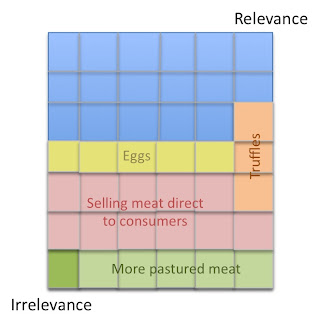
Let's say we work up to 2 flocks of 120 hens each. Let's say they can produce 285 saleable eggs pa. That is 5,700 dozen eggs. At $5 / dozen that is $28,500.
They only lay at that rate for a year - so we'll also have 240 birds a year to sell at next to nothing - or ... Joel Salatin suggests home killing and selling the cooked meat in some ready to eat form. There is a bit of investigation to be done into this idea, but lets assume we can. That might add another $1,500 - which is quite close to next to nothing ...
However, it adds up to another 5 squares to the cause.
It's worth noting that this again assumes selling directly to consumers. Selling into the industrial system would produce, I suspect, less than a third as much. 5,700 dozen is a somewhat intimidating number to have to move, but clearly necessary if we're to get to our goal.
Sunday, February 1, 2009
Economic relevance - episode 3

In episode 2 we managed to make quite a lot of (theoretical) progress by committing to selling our meat direct to consumers. Like a lot of things - supermarkets seem to me to be something that might have once had some logic and benefit, but are now now riddled with dis-benefits and dependent on market power to maintain their position.
I suspect (and hope) they're actually ripe to lose market share. I quite like the idea that, after decades during which supermarkets have ruthlessly shortened the supply chain and then squeezed producers without regard to sustainability, that conditions are developing where it will be possible to 'disintermediate' them.
But episode 3 is going to go in a different direction - to paddock 60 - wherein we have established our trufferie.
I have to say I've noticed more than a little scepticism in the eyes of a number of people when I've said we are developing a trufferie. Truffles seem to have a bad rep.
I've seen forecasts that say there is a reasonable financial return, but I've also prepared financial forecasts as part of what I do professionally. Discounted cash flow (DCF) analysis strikes me as a thoroughly inappropriate way of determining whether to invest in many (if not most) agricultural projects. The timeframes are simply too long and the revenue streams too uncertain to make the result of an DCF analysis any better than just a careful consideration of 4 things:
- the amount to be invested;
- what must be done well to produce a good crop - and can it be done;
- the net revenue outcome of such a crop - using current market prices and current costs; and
- the fundamentals in the marketplace that might affect costs and prices in the future.
In fact a DCF analysis is quite a good way to mislead investors in an uncertain environment - as MIS promoters have shown over the last 10 years.
Applying this framework (which is what I did), I'm comfortable with the truffle investment. I also know 2 other things:
- For the whole of the period to maturity, the trufferie will add at least its investment cost to the capital value of the farm - were we to sell it; and
- Even if it turns out that there are no truffles, I'll have had a heap of fun trying - and more than enough fun to justify the the investment cost in my mind.
If I assume that we do produce truffles (which is not certain) - but take a reasonably modest view of mature yield at current market prices, the trufferie should enable me to fill in 3 more squares.

Thursday, January 29, 2009
Germs - and common sense
There is a really interesting article in the New York Times today on the effect of too much hygiene.
Anyone who grew up on a farm intuitively knows the truth of the old saying 'a bit of dirt never hurt anyone too much'. When you think about the NY Times article, the message gets a bit more nuanced. It really says:
- dirt doesn't hurt you very much or very often; but
- excessive cleanliness hurts you definitely and quite seriously.
What a useful call for moderation and common sense over misapplied psuedo science.
Farming has suffered significantly from scientific over-reach during my life time - a little of this looks good, therefore a lot must be better. Isn't gorging on a 'good thing' at the heart of the industrial food system and its failings?
I'm rarely (if ever) attracted to conspiracy theories that say Monsanto or Gunns or some other corporate hate magnet is bent on doing the devil's business. It always strikes me as much more likely that they're just doing more of what has succeeded for them in the past - and, in doing more of it, they've gone past the point where it's still a good thing.
A bit like cleanliness really ....
Subscribe to:
Posts (Atom)