Showing posts with label WWOOFing. Show all posts

Wednesday, January 8, 2014

Permaculture Principle No 3 - Obtain a Yield

I've just spent a day at our McKerrals Tree Farm trying to work out how to 'take a yield' from something I have to do to manage part of our forestry interests.

Until 2010 we leased part of the farm to another party who grew Eucalyptus Globulous (Tasmanian Blue Gum) to produce wood chips for export to Japan - where it is used to produce high quality paper.  During the summer of 2009/10 they harvested their crop and left me with stumps - from which it is possible to produce what is known as a 'coppice rotation'.

Over the 4 years since harvest each stump has sent up between 2 and 6 separate stems.  They are now from 3 to 8 metres tall.  The task now is to select one stem to grow on - and remove the rest.

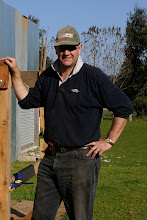
This photo shows Soeren (a WWOOFer) starting into the process - using a fantastic little arborist chainsaw I got last week.  It's only 3 kg - and designed to be used with one hand or two.

Soeren is taking out the first stem here.  The next photo shows him about to take out the last waste stem leaving just one (hopefully the best and straightest) to grow on for another 8 or 9 years.


While the little chainsaw seemed to do a great job, I'm very interested to see what a group of contractors we have coming in a week or two use for the task.  Their quote is $638 per 1,000 treated stumps.

Many stumps are easier that the one shown in the photos - but others are worse.  Nearly all have small, dead twiggy bits that need to be brushed away before you can get at the base where the cuts need to be made.  And the tolerance for any damage to the retained stem is ... zero.

Having done a few trees now myself, 63.8 cents a tree seems like not a lot of money for the job.

In David Holmgren's book Permaculture - Principles and Pathways Beyond Sustainability the 3rd principe is Obtain a Yield.  In this spirit I looked at the coppicing process and wondered whether it might not be possible to 'obtain a yield' beyond the 2022 chip harvest.

In the normal course of plantation forestry the pruned stems are just 'cut to waste' - that is they are just allowed to slowly rot on the ground.  It occurred to me that perhaps the pruned stems might be used as firewood?  From the research I've done, Tassie Blue Gum is regarded as reasonably good firewood - and, if we're using something that would otherwise just decompose, it is definitely from an 'eco-friendly' source.

The issue is that, when cut, it is green and not suitable for burning.  It needs several months (at least) to cure.  So we need a way of allowing it to cure - before being able to cut and package it.

Step 1 is to trim the pruned stems to the point where the diameter gets too small to make acceptable firewood.

Step 2 - we drag it to the edge of the plantation.

Step 3 involves using a hand held machete to trim off the leafy branches and twiggy bits.

What we then have is a trimmed sapling up to 100 mm in diameter at one end and down to about 40 mm in diameter at the other end.  They are between 3 and 5 metres long.  They are ready for 'curing'.

I've had various ideas about what to do next, but the best so far involves building a simple frame from shorter bits that keeps the wood for curing well off the ground.  The next photo shows the first attempt.

I emphasise ... this was the first attempt.  The second was lower to the ground (half this height) and used heavier stems.

The stems are dug in about 3-400 mm - and I use the small chainsaw to 'shape' the top of the post into a U.  With this one I put a screw in to hold the cross piece.  With the heavier stems on the Mark II version - my screws were not long enough - so they just rest in the U.

Once I have sufficient stems to make a bundle which I think might weigh between 500 and 800 kgs, I used a polyester strapping system to hold it all together.  

The plan is to come back when the stems have cured and tighten the strapping up.  Then, with a tractor with a front end loader, I can lift the firewood bundle onto a truck or trailer and bring the firewood back to Moora Farm.

There I have another tractor with an FEL.  I will use it to put the bundle of cured firewood onto something I build late last year from scrap I had from dismantling cattle yards when we first came to Moora Farm.

I built it to help me cut up 'logs' of sawmill offcuts I get from Frosts Sawmill in Monegeetta.  These 'logs' are about 5 m long, 1 m in diameter and bound with steel strapping.  They are a great way to get firewood, but lying on the ground, it's hard to finish cutting it to length.

With this table, I just lift the 'log' onto the table - and cut it there at a comfortable height and with no risk of blunting my chainsaw chain by touching the ground.  I think it will work just as well with my eco-firewood bundles.

So - I'm taking firewood orders.  Maybe for this winter - we'll have to see.

Oh - and, once the coppice pruning is done and the firewood recovered, the plantation looks like this.

Thanks Soeren and Alessio (my helpers)!  Although we only did about 120 stumps we learned a bit about what might or might not work.  There are another 46,880 stumps to do over the next few months.


Sunday, May 26, 2013

Chelsea Flower Show and growing some Fodder Beet


I'm in London at present (for Board meetings) and took the opportunity to attend the final day of the Chelsea Flower Show.  The Concierge at my excellent hotel did what concierges are supposed to do and found me a ticket.

It was only a short taxi ride and I was there soon after gates opened at 8am.  What can I say ... in the main it is very English - so it was lovely.  But the things that really caught my eye were not, in the end, English at all.  The first was a garden called 'After the Fire'.  Until I looked just now I didn't realise that it was an award winner - but ... there you go.  The first thing I noticed was what looked to me like a plant that grows on my roadside at Moora Farm.  I know it as Black Wattle.  The lady I talked to said it was Acacia Dealbata - which Wikipedia describes at a Silver Wattle.

So it was after an Australian fire?  Well no actually - the people are from Mediterranean France - and the wattle is an import there.  The garden was still reminiscent of home - and beautiful.  There was some sort of a tie up with a Cancer charity involved and the parallel was drawn between after a wildfire - and after Chemotheraphy.   Which made me think of good friends dealing with that challenge at present.

The other highlight for me was meeting a man called Jaap Sneeboer - the owner of a Dutch company that makes traditional hand forged garden tools.  Two or three weeks ago I was in a little town called Trentham - not far from my home in Australia.  I found a little shop called Phillip&Lea that, it turned out, had only opened that very day.  It sells a slightly eccentric mix of cooking equipment and gardening tools - with the gardening part of the range being ... Sneeboer hand tools.  I bought a beautiful hand weeder for a not unreasonable price - given its quality and functionality.

I was able to tell Jaap the story and hear a little of his.

He has just put out a new form of a Dutch hoe - which he calls a Royal Dutch Hoe.  I seriously covet one!  It's not only the hand forged tool head - but the handle is great as well.  Being made by Dutchmen the handle on the standard how was almost long enough for me - but Jaap said they had a longer handle still.  I gotta get one!

I'm particularly interested in hoes at present - because I'm growing a crop for stock feed called Fodder Beet (or Mangel Wurzel)  My Dad grew it in the 1960s for a few years and they produce a large beet (several kilos) - which is a very nutritious cattle feed - though in what combination with hay or other dry food I am yet to find out.

I planted several small areas totalling perhaps a quarter of an acre in March and early April.  The first photo is of one of the WWOOFers (Alex) doing the fairly laborious job of the first thin.

The seeds come in small clumps naturally - and so after about 3 weeks it is necessary to thin them to about 3 inches apart.  When they are fully grown the spacing will need to be more like 6 to even 12 inches - but I'm intrigued by the capacity to 'take a yield' along the way to feed to chickens or sheep - which will be mainly tops as opposed to the root dominance there will be later on.

The second photo shows two more WWOOFers (Ashleigh and Lisa) weeding the same fodder beet after they have been growing for nearly 2 months.  They now are at the stage where a further thinning can be fed out.

The interest in hoes comes from the thinning and weeding tasks.  I remember when I weeded fodder beet for my Dad it was with a home made triangular headed hoe.  If I remember correctly, he was most pleased with himself and thought it better than the available alternatives.

I already have a variety of hoes - but none that seems to do the job better than bending one's back and hand weeding.  I'm hoping that a Royal Dutch Hoe will make a difference.

Depending on how this autumn planted crop produces, I may grow more over time.  I suspect it can help me fill both my summer and winter 'feed gaps'.  This crop will be ready (I hope) during winter or very early spring. If I plant another crop in (say) November - It would help deal with the late summer grass growth slowdown.

The stock definitely need to be trained to it.  They don't rush it at the moment - not like our pigs did in the 60s - and others have told me cattle will once they get the taste for it.

I also don't think I'd do it without the WWOOFer help - as thinning and weeding is hard work.  But I'm not asking you to do anything I haven't done guys!

Sunday, September 18, 2011

WWOOFing

S
Our son has done the work to register us as hosts under a scheme called Willing Workers On Organic Farms.

We now have a host number - VM 259 - and we are waiting for someone to tell us they want to work with us for 4 to 6 hours a day in return for board and lodging.  Someone who does this is called a WWOOFer.

We are not a certified organic property.  We don't have to be - it's enough that we are mainly organic and don't ask our WWOOFers to use any chemicals or non-organic remedies. 

A neighbor has been hosting WWOOFers for some time - and we've had a couple of groups of them around to dinner - just to give her a break.  They were all nice kids.

We have quite a lot going on at present, so it will be good to have some help.  The two Maremma pups take quite a lot of time.  They are fed 3 times a day and taken for a short walk each time.  We're also trying to socialise them to the animals they have to guard as well.

Josie is doing well with the chooks, but still needs to be supervised.  The sobering part is that she will need to be supervised until she 'matures' - which could be a year away!

Polo is also doing ok with the sheep, but we definitely need to supervise his interaction with the ram.  Even the ewes are a bit aggressive with him.  He, for his part, is wanting to run around and play.  When the ram does try to butt him, Polo stands up for himself by barking and 'charging' back in a 'get off me' sort of way.  Having observed it a couple of times I think it's borderline what he should be doing to establish his role as their protector.

People say that it's best to get a pup and train them yourself - but that's a non-trivial undertaking.

Yesterday we drove down to Buln Buln in Gippsland and bought 6 fresian steers from a dairy farmer.  Our reason for doing so is that we just don't have enough cattle to eat all our grass at Moora - let alone at the leased farm at Benson Rd.

We now have 6 steers of about 6 weeks old.  They were advertised as weaners, but are really a bit young for weaning I think.  We have a bag of milk powder / calf formula and have started out giving them 2 litres each once a day.  The farmer gave us an old feeder - which I think was a hint to continue giving them milk for at least a week or two. 

We will probably get another 6 in a few weeks, but will see how these ones go first.  Whereas we grow our Belted Galloways to sell the meat direct to consumers, we intend that the dairy breed steers will be grown through to the end of Spring next year - and sold on the market.

Moora is 57 acres.  Benson Rd is around 100 acres.  I think, with the effort going into cell grazing, we can look at eventually having a herd of 50 Belted Galloway cows - plus the growers that come from that.  Taking the steers through to 24 to 30 months will give us about 125 head.  At present we have nearly 60 - so with a few more calves ... we'll be half way there.
F